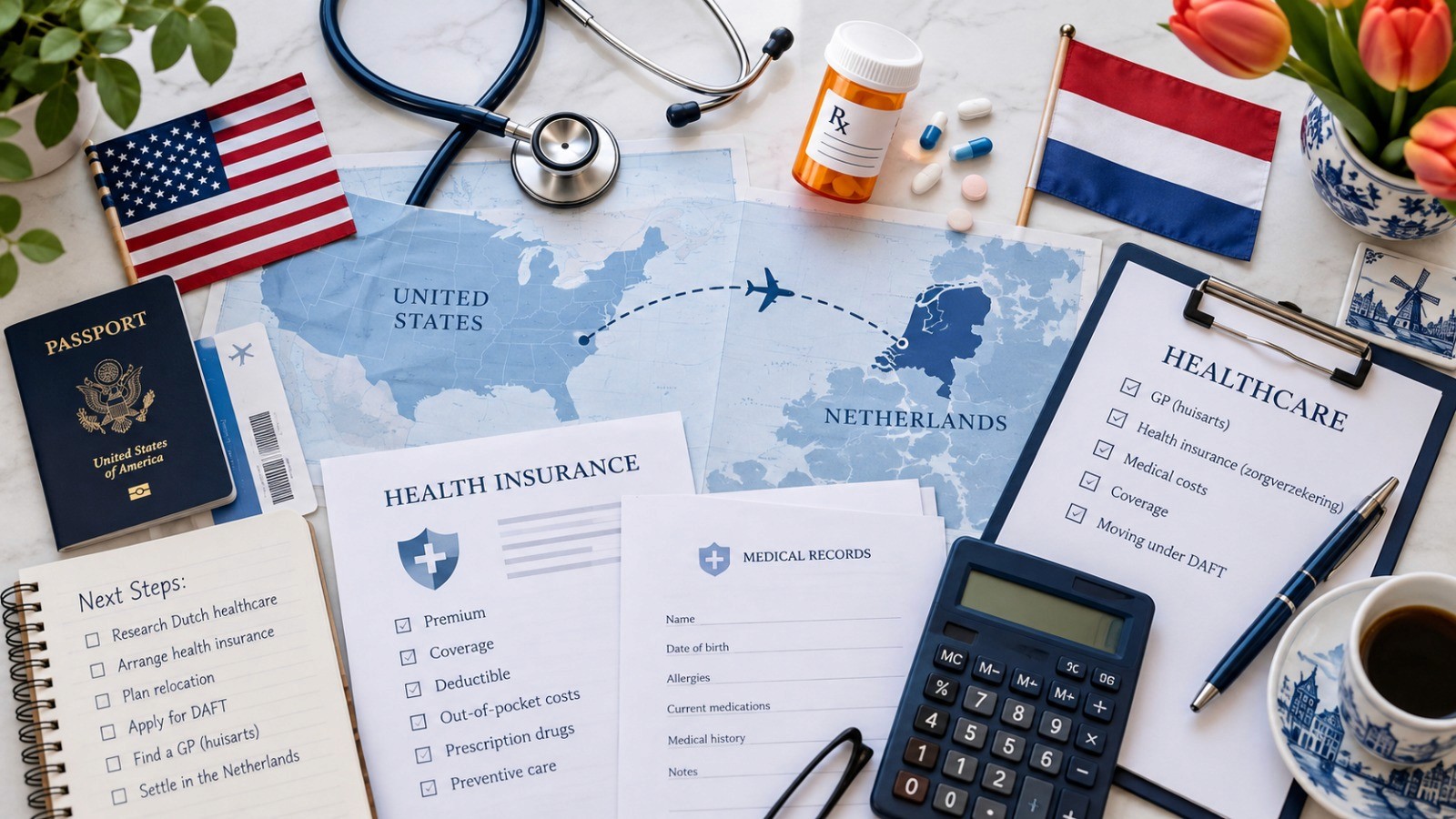
Healthcare in the Netherlands for Americans on DAFT: A Complete 2026 Guide
If you're an American planning to move to the Netherlands, understanding the healthcare situation in your new host country is going to be on top of your list. In this article we will give a short overview of Dutch health insurance costs, coverage for hospital treatment, considerations for pre-existing medical conditions, and your Dutch healthcare coverage during the visa application process.
It is important to understand that the Netherlands has a very different healthcare system than the United States - and mostly in a very beneficial manner. Healthcare is provided through a combination of private health insurers and government regulation, at a far more affordable rate than in the United States. Americans moving under the Dutch American Friendship Treaty (DAFT) to the Netherlands will obtain access to the same basic healthcare insurance system as Dutch citizens. In this article we will give you the short breakdown.
1. How does healthcare in the Netherlands work?
The Dutch healthcare system is based on mandatory private health insurance, regulated by the Dutch government. Everyone aged 18 or older who is required to have Dutch health insurance must purchase a basic insurance policy, known as the basisverzekering. Children under 18 are covered within the health insurance of their parents, usually at no additional surcharge.
The government determines which medical treatments must be covered under this policy. All Dutch health insurers must offer this standard coverage. The basic package generally includes:
Visits to a general practitioner (GP)
Hospital treatment and specialist consultations
Emergency medical care
Most medically necessary prescription medication covered under the basic package
Maternity care and childbirth services
Certain mental healthcare treatments
Certain other medically necessary services, subject to coverage conditions
An important difference from the American healthcare system is that Dutch health insurers cannot reject applicants for basic insurance because of pre-existing medical conditions. They are also forbidden from charging higher basic insurance premiums based on someone's individual medical history. Supplementary insurance is different: insurers may apply additional conditions to optional policies.
Dutch Healthcare insurance is not tied to employment. It’s an individual deal and the costs are carried privately. Being self-employed under the Dutch American Friendship Treaty visa therefore has no impact on healthcare eligibility. Employer coverage of healthcare insurance is unusual in the Netherlands. Self-employed Americans moving to the Netherlands under DAFT should understand that personal health insurance premiums are generally not tax-deductible business expenses.

2. Is Dutch health insurance mandatory for Americans on DAFT?
Yes, if you meet the DAFT requirements. Americans who establish their residence in the Netherlands under DAFT will normally be required to take out Dutch basic health insurance.
Your choice of self employed setup as either ZZP or BV+30% does not change this, nor does the origin of your business revenue (for example 100% US based clients). So when working under a Netherlands registered company form, you are working for a Netherlands company when insurance companies ask this question. The fact that your Netherlands company services only US clients has no influence on this.
If you are working to a large extent outside the Netherlands, that could mean you are instead subject to that other country’s social security system. For Americans who work in multiple countries, the Dutch Social Insurance Bank (Sociale Verzekeringsbank, or SVB) can assess which social security legislation applies and whether they are insured under the Dutch Wlz system. For more information, see the official SVB guidance on working outside the Netherlands.
Can you keep your American health insurance instead?
It is strongly recommended to keep your US healthcare insurance, until you have obtained your Dutch healthcare insurance. Once you have obtained your Dutch healthcare insurance, it makes no sense to keep your US coverage in addition to this (under normal circumstances). You may still choose to retain additional private international coverage, for example for treatment abroad.
3. When should you arrange Dutch health insurance under DAFT?
This is an important point for Americans moving under DAFT, because immigration and healthcare insurance eligibility do not necessarily begin on the same date. This is because of the distinctive residence endorsement sticker Americans are able to obtain during the process, while awaiting the final verdict on their DAFT application. We explain this process in our five-step guide to the Dutch American Friendship Treaty visa.
This sticker allows for a lot of things, including working (under conditions) and residing in the Netherlands, registering for BSN and getting a Dutch bank account. But for Dutch healthcare insurance coverage, insurance providers normally require the final residence card. This comes at the tail end of the DAFT visa application process.
Newly arriving DAFT applicants registering for their BSN numbers are subject to the obligation to register for Dutch healthcare insurance, but they receive a 4-month respite to actually obtain it. This is normally enough to obtain the residence card, and therefore acceptance from a healthcare provider for healthcare coverage. Once the coverage is obtained, it will work back retroactively to the date on which the insurance obligation came into existence. This date will normally be established by the Dutch health insurance provider, based on the date of municipal registration (BRP), the effective starting date of the residence permit, and supporting evidence concerning housing, employment and business activities. In cases of uncertainty, the Dutch Social Insurance Bank (SVB) can formally determine when the insurance obligation commenced. Provided that health insurance is arranged within four months of the start of the insurance obligation, both coverage and premiums are applied retroactively to that date.
We recommend arranging appropriate temporary or international health insurance for any period during which Dutch basic health insurance is not yet available. Make sure that temporary insurance actually covers relocation, rather than just a tourist visit. Once you become eligible for Dutch basic health insurance, contact an insurer promptly to establish your coverage.
4. How much does Dutch health insurance cost in 2026?
The Dutch healthcare system is funded in two main ways: individual healthcare premiums and Income-dependent healthcare contribution (Zvw), which is part of your income tax bill. Individual health premiums are generally more predictable than many Americans are accustomed to. There are two main components to understand.
A. Monthly health insurance premium
In 2026, the average premium for Dutch basic health insurance is €157 per adult per month, according to the Dutch government. Individual policies may cost more or less, depending on the insurer, policy conditions and voluntary deductible. A couple with two adults can therefore budget approximately 2 x € 157 = €314 per month for basic insurance, using the national average. Children under 18 do not pay basic insurance premiums, but are instead covered under their parents’ insurance scheme.
B. Annual deductible: eigen risico
Every adult insured under the Dutch basic healthcare system is subject to an annual mandatory deductible, called the “Own Risk” or Eigen Risico. In 2026, the mandatory deductible is €385 per adult per calendar year. This means that you normally pay the first €385 of yearly covered healthcare expenses yourself, after which the insurer pays the covered costs. Exceptions apply.
And then there is the Income-dependent healthcare contribution: Zorgverzekeringswet, or Zvw. This is an income-related contribution under the Healthcare Insurance Act, which is part of your income taxation. In 2026, the Zvw contribution is assessed directly on qualifying income, including self-employment income, generally at 4.85%. The maximum contribution income is €79,409. Again, all part of your income tax calculation.

5. What medical treatments are covered by Dutch health insurance?
The Dutch basic healthcare policy provides broad coverage for medically necessary healthcare, but Americans should be aware of several differences in how treatment is organised.
General practitioner (huisarts)
Your GP, known in Dutch as a huisarts, is the central point of contact for most non-emergency medical issues. In Dutch this is called the “first line of healthcare”. You register with a GP in your local area.The GP handles common illnesses, medical advice, preventive concerns and referrals to specialists. Importantly, consultations with your GP are covered under basic Dutch health insurance without applying the annual deductible.
Hospital treatment and medical specialists
If you need specialist care, your GP will normally refer you to a hospital or specialist. Covered hospital treatment is generally paid through your basic health insurance, subject to the deductible and policy conditions. Depending on the treatment and availability, you may have to wait for a specialist appointment.
Prescription medication
Many prescription medications are covered, but not every medicine or brand is automatically reimbursed. Insurers may prefer certain generic medications, and the Dutch coverage list may differ from the medication available under your American insurance. If you take prescription medication regularly, it is sensible to bring a summary of your prescriptions and medical history.
Dental care
This is an area where Americans should pay particular attention. Routine dental care for adults is generally not included in basic Dutch health insurance. This means that regular dental check-ups, cleanings and common treatments are usually paid out of pocket unless you purchase additional dental insurance. Children under 18 receive broader dental coverage through basic insurance, although orthodontics and certain treatments are excluded or subject to special conditions.
6. How does healthcare work for your spouse and children under DAFT?
Many Americans move to the Netherlands under DAFT together with their partner and children. The Dutch healthcare system applies to family members individually, based on their eligibility.
Your spouse or partner
Your spouse or partner will normally require their own Dutch basic insurance policy once they become subject to the Dutch insurance obligation. The insurance requirement is not dependent on whether they work for your company, another employer, or do not work at all. The cost of their basic insurance is separate from yours.
Children under 18
Children need to be registered for basic health insurance, but they do not pay a monthly premium. They are also exempt from the annual deductible. This makes the Dutch healthcare system particularly attractive to families with children, at least in terms of direct insurance premiums.
Additional charges or exclusions can still apply to particular services. We have a separate article about bringing your spouse and children to the Netherlands under DAFT.
7. Can Americans receive healthcare allowance (zorgtoeslag)?
Yes. American citizens may qualify for Dutch healthcare allowance, known as zorgtoeslag, if they meet the normal requirements. Healthcare allowance is a government contribution towards the cost of basic health insurance for people with lower incomes. Eligibility depends on your income, assets, insurance status and household situation.
In 2026, the general maximum annual income thresholds are:
€40,857 for a person without a benefits partner.
€51,142 combined for people with a benefits partner.
There are also asset limits. The relevant 2026 limits are €146,011 for someone without a benefits partner and €184,633 combined for benefits partners. For Americans just starting a Dutch business, zorgtoeslag may be worth investigating, particularly if earnings are initially limited. However, be careful when estimating your income. If your business ends up generating higher taxable income than anticipated, you may have to repay part or all of an allowance you received.
Applications are handled through the Dutch Benefits Agency (Dienst Toeslagen). See the official conditions for zorgtoeslag.
DISCLAIMER
Cardon & Company are not healthcare providers or specialists. This article is for general informational purposes only. Cardon and its employees are not qualified to answer further healthcare related questions. If you wish to know more about the Netherlands healthcare system, you can check out Netherlands healthcare insurance offerings on www.independer.nl or you can reach out to concierge services like LNGVTY.